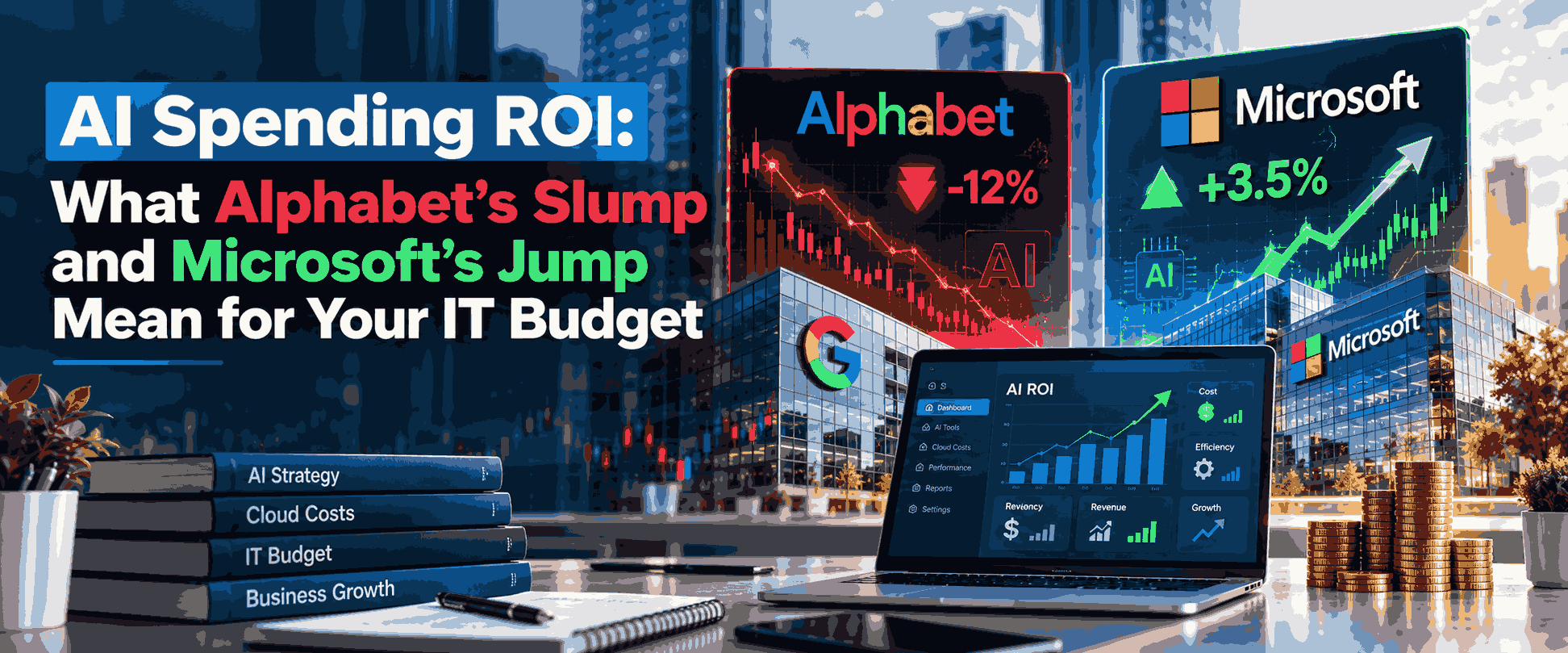
AI spending ROI was the real story behind Big Tech’s earnings on October 29, 2026. Investors rewarded the company that could show returns and punished the one that could not. The same test works on your own AI tools, cloud contracts and marketing spend.
- On October 29, 2026, Nasdaq futures fell after Alphabet and Microsoft reported very different quarters. Alphabet dropped about 12% in regular trading, while Microsoft’s cloud numbers gave investors something to like.
- Investors did not reject AI spending itself. They rewarded visible revenue and punished cash burn.
- You can run a five-question payoff test on every AI tool and cloud subscription you pay for. It takes about an hour.
- This article is business and IT guidance, not investment advice.
What happened on October 29
Nasdaq futures slid on Thursday after mixed results from two of the largest AI spenders. According to Reuters, Alphabet fell 10.5% in premarket trading after weak results in its core search advertising business and a sharp rise in cash burn tied to its AI buildout. Microsoft rose 3.5% premarket after beating expectations on cash flow and forecasting strong cloud growth. The reaction came a day after the Federal Reserve held interest rates steady, with two policymakers preferring a quarter-point hike.
By the close, Alphabet was down roughly 12%, and CNBC reported its free cash flow was negative $9.07 billion for the quarter. The Nasdaq Composite lost 1.4% while the S&P 500 fell 0.3%. Dow futures rose in the morning as money moved out of technology and into other sectors.
Then Amazon reported after the bell. It missed on both earnings and revenue, held its 2026 capital spending plan at $220 billion, and fell about 6% in extended trading, per CNBC.
Three companies, three different answers
| Alphabet | Microsoft | Amazon | |
|---|---|---|---|
| Headline | Missed expectations; weak search ad results | Beat on revenue and cash flow | Narrow miss on revenue and EPS |
| Cloud/AI signal | Heavy AI spending, cash burn | Azure up 48% to $33.2B; guided 49% to 50% growth next quarter | Capex plan of $220B kept |
| Cash flow | Negative $9.07B free cash flow | Cash flow beat estimates | Negative $42.4B free cash flow |
| Market reaction | About 12% lower on the day | Up in premarket trading* | About 6% lower after hours |
*One midday market report had Microsoft edging lower later in the session, so treat the premarket gain as a first reaction, not a final verdict. Sources are listed at the end of this article.
The lesson underneath the stock moves
All three companies are spending enormous sums on AI infrastructure. The difference is whether that spending is visibly turning into revenue and cash.
Microsoft’s cloud growth gave investors a number to point to. Alphabet’s quarter paired heavy spending with weak results in its core search advertising business. One analyst quoted in coverage described the two reports as competing stories about whether AI investment pays, leaving US markets unsure which to believe.
That is the same question every business owner should ask about their own technology line items. Not “is AI impressive?” but “where is the return, and can I see it?” If you are new to the topic, start with our plain-English guide to managed IT services for small and mid-size businesses.
A five-question AI spending ROI test for your organization
Use this on every AI tool, automation or cloud upgrade you pay for, whether you run a clinic, a hotel, an agency or a small manufacturer.
- What specific task does it speed up or replace? “Improves productivity” is not an answer. “Cuts claim-follow-up work” is. Our look at AI and automation in medical revenue cycle management shows what a specific, measurable use case looks like.
- What was the baseline? Write down hours, error rates or cost per task before the tool, or you will never know if it worked. The cost and accuracy framing in our AI scribe vs human medical scribe comparison is a good template.
- Who owns the result? One named person should review the numbers monthly.
- What data does it touch? If patient or customer data goes in, confirm the vendor’s data handling terms first. Healthcare practices handling protected health information generally need a signed business associate agreement with vendors who process it. Security basics are covered in our PHP2Shell guide, our piece on how generative AI is changing cyber threats, and our checklist of signs your business needs managed cybersecurity.
- What happens at renewal? Check price escalators, usage caps and how hard it is to export your data and leave. If you are weighing who should manage all this, see our in-house IT vs outsourced managed IT comparison.
If a tool cannot pass questions one and two, pause the renewal. That is the small-business version of what Wall Street did to Alphabet this week.
Where this touches IT, marketing and healthcare budgets
This section is our interpretation of the news, not reported fact.
Cloud contracts. When the biggest providers commit hundreds of billions of dollars to infrastructure, they have every reason to push customers toward higher-tier AI bundles. That does not mean prices will rise, but it is a good moment to review what you pay for and what you use. Our top managed IT trends for 2026 and our managed IT guide for hotels and hospitality show what a right-sized stack looks like.
Search and paid ads. Alphabet’s reported weakness was in core search advertising. One quarter is not a trend, and no single report proves search is fading for your market. Check your own numbers instead: cost per lead, conversion rate and branded versus non-branded traffic over the last two quarters. For campaign ideas, see the future of paid ads with AI automation and our guide to generative AI for marketing.
AI agents and managed services. Vendors are racing to sell autonomous tools. Our look at chatbots versus autonomous AI agents covers how to pilot one without handing it the keys.
A 30-day checklist
- Week 1: List every AI and cloud subscription with its monthly cost and owner.
- Week 2: Apply the five-question payoff test and flag anything that fails.
- Week 3: Ask vendors for renewal terms in writing, including exit and data export.
- Week 4: Decide what to keep, cut or pilot, and set one measurable target for each keeper.
Frequently asked questions
Not exactly. Nasdaq futures fell and Alphabet dropped sharply, but Microsoft’s cloud results were received well in early trading. The split suggests investors are sorting AI spenders by visible returns, not abandoning the theme.
Pick one task, record its baseline time or cost before the tool, then compare monthly after launch. If you cannot name the task and the baseline, you cannot measure the return.
Not because of the headlines alone. Pause tools that fail a simple payoff test, and keep those with measurable savings or revenue. Stock moves at a trillion-dollar company are a prompt to review, not a reason to panic.
No. It describes reported events and applies the lesson to business technology decisions. For investment decisions, consult a licensed financial advisor.
About the Author