Key Takeaways
- In the Phase 2 CALM-CSU trial (113 adults), once-daily oral EP262 at 50 mg or 150 mg did not reduce chronic hives activity more than placebo at Week 6.
- Everyone improved, placebo included: UAS7 fell by 10.4 points on placebo, 8.4 on 50 mg and 12.0 on 150 mg. None of the gaps were statistically significant.
- Safety looked clean, with no serious treatment-emergent adverse events. But the trial was small, short and was stopped after its first part.
- EP262 is not an established add-on to antihistamines. Approved second-line options for antihistamine-refractory chronic spontaneous urticaria (CSU) are unaffected.
An experimental pill that blocks a mast cell receptor called MRGPRX2 did not help people with chronic hives any more than a dummy tablet did. That’s the headline from CALM-CSU, a randomized Phase 2 study of EP262 published in Allergy in 2026.
What EP262 is trying to do
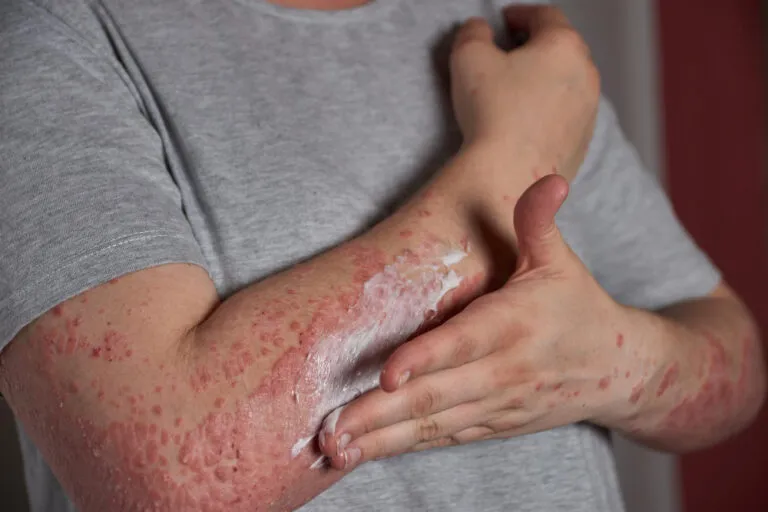
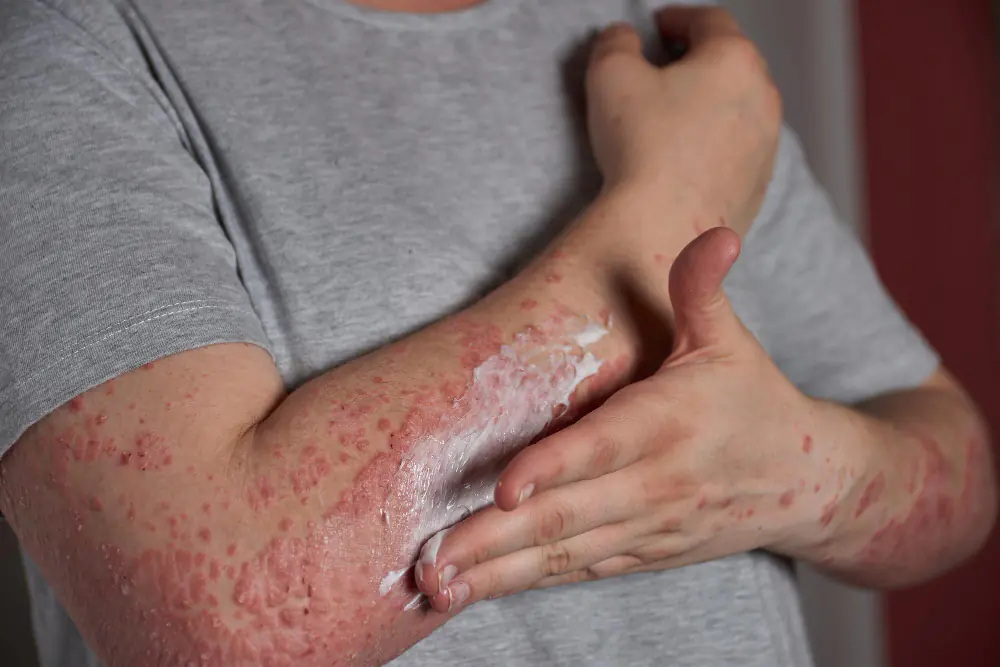
Chronic spontaneous urticaria (CSU) means itchy wheals, deep swelling (angioedema), or both, showing up for longer than six weeks with no obvious outside trigger. Mast cells sit at the center of the disease. Pooled data put chronic urticaria at roughly 1% of the general population, and it often lasts for years.
Most existing drugs act on the IgE pathway or on signals downstream of it. EP262 takes a different route. It’s a once-daily oral antagonist of MRGPRX2, a receptor on mast cells that can trigger degranulation without IgE involvement. The idea was simple: if that pathway drives symptoms in people who still have hives on antihistamines, blocking it should help.
Preclinical work looked encouraging. EP262 reduced mast cell degranulation in a humanized mouse model and in ex vivo human skin, and a Phase 1 study in healthy volunteers found it safe at the doses tested.
How the CALM-CSU trial was run
The multicenter, double-blind study randomized 113 adults to one of three arms, all taken once daily on top of a stable second-generation H1 antihistamine:
| Arm | Daily dose |
|---|---|
| EP262 | 50 mg |
| EP262 | 150 mg |
| Placebo | n/a |
To qualify, patients were 18 to 80 years old, had lived with CSU for at least six months, and still scored 16 or higher on the seven-day Urticaria Activity Score (UAS7) despite antihistamine treatment. UAS7 is a patient-reported score that combines daily itch severity and hive count over a week. A total of 107 patients finished treatment.
The primary endpoint was the change in UAS7 from baseline to Week 6.
The results: placebo kept pace
All three groups got better. That’s a familiar pattern in urticaria trials, where placebo responses are often large. The least squares mean UAS7 reductions were:
- Placebo: 10.4 points
- EP262 50 mg: 8.4 points
- EP262 150 mg: 12.0 points
Neither dose separated from placebo. The estimated difference versus placebo was 1.99 points for 50 mg (90% CI -1.96 to 5.94; p=0.4059) and -1.53 points for 150 mg (90% CI -5.49 to 2.42; p=0.5213). Both confidence intervals comfortably include zero.
Secondary readouts, weekly itch scores and weekly hive severity, told the same story. So did the exploratory outcomes.
Safety and tolerability
Both doses were generally well tolerated. There were no serious treatment-emergent adverse events, and no treatment-related events of Grade 3 or higher. Vital signs, ECGs and lab results showed no clinically meaningful pattern of concern.
A clean safety profile is useful for the MRGPRX2 target in general, but it can’t rescue a drug that doesn’t show efficacy.
Why the trial can’t answer every question
The authors point to a small sample, a short six-week treatment window and limited population diversity. There’s also a design wrinkle worth knowing. The trial was planned in two parts, and the registry record on ClinicalTrials.gov (NCT06077773) states the study was stopped after Part 1 for business reasons, with Part 2, which would have tested a lower dose, never enrolled. The published summary links the termination to the lack of efficacy, so the exact reasoning is worth checking against the full paper.
Either way, a negative result here means EP262 didn’t work at 50 mg or 150 mg over six weeks in this population. It doesn’t rule out every possible use of MRGPRX2 blockade, such as longer treatment, other doses or other mast cell diseases.
What it means for clinicians and patients
Nothing changes in practice. Under the 2026 international urticaria guideline, second-generation H1 antihistamines remain first-line, with escalation up to four times the standard dose, and remibrutinib, omalizumab and dupilumab are the listed second-line options for patients who stay symptomatic. EP262 doesn’t join that list on this evidence.
Patients with persistent hives shouldn’t read this as a sign that treatment options are thin. They should still talk with an allergist or dermatologist about whether dose escalation or an approved add-on makes sense for them.
FAQ
Not in this trial. Both doses improved symptoms, but no more than placebo did.
Yes, within the limits of a short study. No serious treatment-emergent adverse events were reported.
A receptor on mast cells that can set off degranulation independently of IgE. EP262 was designed to block it.
No. It’s an investigational drug, and this Phase 2 result does not support moving it forward as an antihistamine add-on for CSU at these doses.
About the Author