For more than a decade, digital marketing followed one dominant assumption: if you rank on Google, you win. Entire businesses were built on this belief.
In 2025, that assumption is no longer reliable.
Search behavior has fundamentally changed due to AI-generated answers, zero-click searches, fragmented discovery journeys, and increasing algorithm volatility. As a result, relying solely on Google SEO now creates significant traffic and revenue risk.
This article explains—using verified research and official documentation—why Google-only SEO is no longer enough and how a multi-search engine optimization strategy has become essential.
1. How Search Changed Between 2020 and 2025
Search today is no longer just a list of links.
AI Became the First Answer Layer
Google now displays AI Overviews (formerly SGE) that summarize answers directly on the search results page. According to Google’s own announcement, AI Overviews are designed to help users “get answers faster without needing to click multiple links”
👉 Source: Google Search Blog
https://blog.google/products/search/generative-ai-search/
Independent research confirms the impact. A 2024–2025 analysis by Search Engine Land shows that zero-click searches are increasing, especially for informational queries
👉 Source: Search Engine Land
https://searchengineland.com/zero-click-searches-up-organic-clicks-down-456660
Implication:
Ranking #1 no longer guarantees traffic.
User Discovery Is Fragmented
Users now discover content via:
- Search engines
- AI assistants
- Desktop OS search bars
- Browser-embedded AI tools
- Voice search
Google itself acknowledges that search journeys are no longer linear
👉 Source: Google Search Central
https://developers.google.com/search/docs/fundamentals/creating-helpful-content
SEO must now optimize for visibility across ecosystems, not just clicks.
2. The Hidden Risk of Depending Only on Google SEO
Most websites still receive 80–95% of organic traffic from Google. That level of dependency creates a single point of failure.
Algorithm Volatility Is Increasing
Google core updates increasingly:
- Reinterpret search intent
- Reclassify content quality
- Devalue entire site sections
Google explicitly states that ranking changes may occur even if no rules are violated
👉 Source: Google Search Central – Core Updates
https://developers.google.com/search/updates/core-updates
Businesses that rely solely on Google often experience:
- Sudden traffic drops
- Long recovery cycles
- Revenue instability
This is not an SEO issue—it’s a business risk issue.
3. Why Google SEO Alone Is No Longer Enough in 2025
Reason 1: Zero-Click Searches Reduce Traffic Potential
A study compiled by Bain & Company highlights that AI-driven answers reduce traditional website visits while increasing brand exposure inside search interfaces
👉 Source: Bain & Company
https://www.bain.com/insights/goodbye-clicks-hello-ai-zero-click-search-redefines-marketing/
SEO success must now include visibility, not just visits.
Reason 2: Competition on Google Is at an All-Time High
Every brand optimizes for Google first:
- Higher content costs
- Slower ranking timelines
- Diminishing ROI
Meanwhile, alternative search platforms remain less competitive.
Reason 3: Search Is No Longer Google-Only
Modern search includes:
- Bing
- Desktop and enterprise search
- AI-powered assistants
Ignoring these channels limits discoverability.
4. Bing’s Growing Role in Modern SEO

4
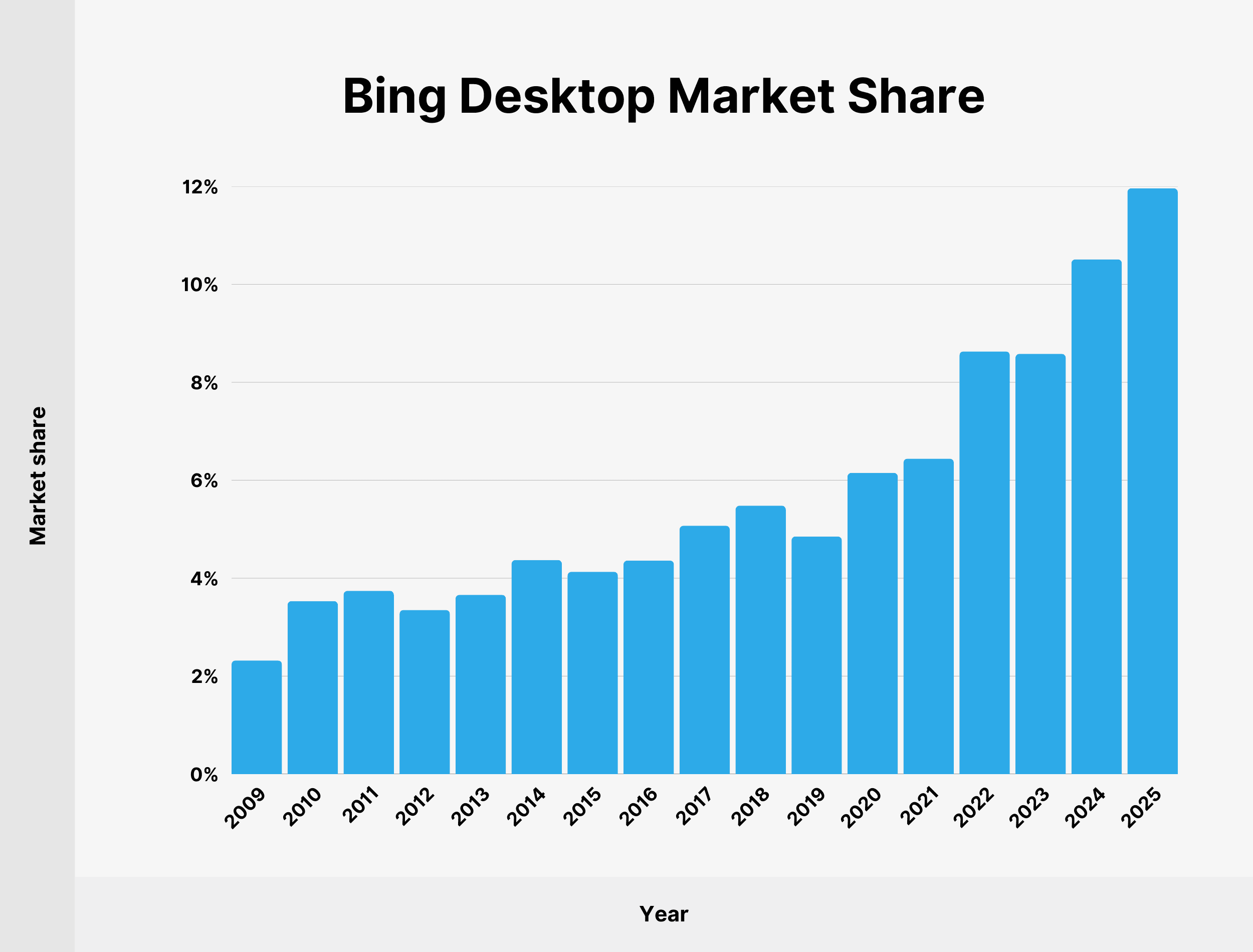
Bing is no longer a secondary search engine.
Why Bing Matters in 2025
Microsoft has deeply integrated Bing into:
- Windows OS search
- Microsoft Edge
- Enterprise environments
- AI-assisted search experiences
Microsoft officially confirmed Bing’s AI transformation and OpenAI integration
👉 Source: Microsoft Blog
https://blogs.microsoft.com/blog/2023/02/07/reinventing-search-with-a-new-ai-powered-microsoft-bing-and-edge-your-copilot-for-the-web/
Bing Traffic Quality
Multiple industry benchmarks show that Bing users:
- Have higher purchasing power
- Convert better in B2B, healthcare, finance, and local services
👉 Source: AMRA & Elma – Bing Ads Statistics
https://www.amraandelma.com/bing-ads-statistics/
Lower competition + higher intent = strong ROI.
5. Google vs Bing SEO: Strategic Differences
| Factor | Bing | |
|---|---|---|
| Ranking logic | AI + intent | Rule-based + AI |
| Keyword matching | Semantic | Exact match matters |
| Meta tags | CTR focused | Ranking influence |
| Social signals | Indirect | More influential |
| Competition | Very high | Moderate |
Microsoft confirms Bing places greater importance on on-page clarity and metadata
👉 Source: Bing Webmaster Guidelines
https://www.bing.com/webmasters/help/webmasters-guidelines-30fba23a
6. AI Search Changed the Goal of SEO
The goal of SEO is no longer “rank and get clicks.”
The new goal is:
Become a trusted source that AI systems choose to reference.
Google’s quality documentation emphasizes E-E-A-T (Experience, Expertise, Authority, Trust) as critical signals
👉 Source: Google Search Quality Rater Guidelines (summary)
https://www.searchenginejournal.com/google-e-e-a-t/472764/
Backlinko’s 2025 research confirms that authoritative, well-structured content is more likely to be cited by AI systems
👉 Source: Backlinko
https://backlinko.com/google-e-e-a-t
7. What a Multi-Search Engine SEO Strategy Looks Like
Shared Technical Foundation
Google confirms that Core Web Vitals remain essential ranking signals
👉 Source: Google Developers
https://developers.google.com/search/docs/appearance/core-web-vitals
These optimizations benefit all search engines, not just Google.
Dual Content Optimization Model
For Google
- Topic clusters
- Semantic depth
- Helpful content
For Bing
- Exact keyword usage
- Clear H1/H2 structure
- Strong metadata
Bing officially recommends clear keyword targeting and structured content
👉 Source: Bing Webmaster Tools Documentation
https://learn.microsoft.com/en-us/bingwebmaster/
New SEO KPIs
Modern SEO measurement includes:
- Search impressions
- AI citations
- Brand mentions
- Assisted conversions
Clicks alone no longer reflect real visibility
👉 Source: Search Engine Land
https://searchengineland.com/seo-metrics-beyond-clicks-2025-451920
8. Who Benefits Most From Multi-Search SEO?
- B2B companies
- Healthcare providers
- SaaS platforms
- Local service businesses
These industries rely on trust and decision-stage users, not mass traffic.
Final Takeaway
Google still matters—but Google alone is no longer enough in 2025.
A Google-only SEO strategy:
- Increases risk
- Limits visibility
- Misses AI and alternative search traffic
A multi-search engine optimization strategy:
- Stabilizes growth
- Improves conversions
- Future-proofs discoverability
The real question is no longer:
“How do I rank on Google?”
The right question is:
“How do I stay visible wherever people search?”
FAQ’s
Google SEO alone is no longer enough because search behavior has changed. AI-generated answers, zero-click searches, and frequent algorithm updates mean websites can lose traffic even when ranking well. Relying on a single search engine increases business risk and limits visibility across emerging search platforms.
Multi-search engine optimization is a strategy that focuses on optimizing a website for multiple discovery platforms instead of just one. It includes optimizing for Google, Bing, AI-powered search results, voice search, and other search ecosystems to improve stability, reach, and conversions.
Bing SEO helps reduce dependency on Google by providing an alternative source of organic traffic with lower competition and often higher conversion intent. Bing users tend to be decision-ready, especially in B2B, healthcare, finance, and local services, making it a valuable diversification channel.
No, AI search does not replace SEO, but it changes how SEO works. Instead of focusing only on rankings and clicks, modern SEO prioritizes content clarity, authority, structured data, and trust so that AI systems can reference and summarize the content accurately.
The biggest benefits include reduced traffic volatility, better long-term visibility, higher-quality leads, improved conversion rates, and protection against sudden algorithm changes. A diversified SEO strategy makes businesses more resilient and future-ready in an AI-driven search landscape.